A spa is the smallest water project most homeowners take on and easily one of the most enjoyable, because it is the feature people actually use several times a week rather than a few times a season. The same simple brief, somewhere to sit in hot water outdoors, can mean a portable unit delivered on a pallet next week or a gunite structure engineered into a hillside terrace over several months, and both can be wonderful.
The cost difference between those two runs to an order of magnitude, so it is worth understanding how the options really differ and what each one asks of your property before you settle on one. Here is how we think about it.
Three Ways to Add a Spa
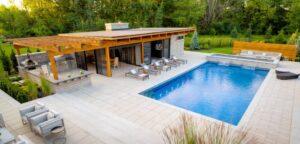
A built-in spa shared with a pool is the most economical route to a permanent spa if you are already building or remodelling a pool, because it shares the shell, the excavation and much of the equipment, and a shared heater and pump keeps running costs down nicely. A spillway into the pool is the usual arrangement and it looks beautiful. The one constraint is obvious, which is that it only makes sense if there is a pool.
A standalone gunite spa is built the same way as a pool, in its own excavation with its own equipment pad, gas and electrical, which means it can go exactly where you want it, usually much closer to the house than a pool would sit. It can be set into a terrace, raised with a seat wall, finished in the same stone as the surrounding hardscape, and shaped to the space, so it reads as part of the garden rather than an addition to it. It costs considerably more than a portable unit and it is permanent, which for the right household is precisely the appeal.
A portable or acrylic spa arrives as a finished shell with its equipment built in, needing a level pad rated for the load, a dedicated electrical circuit, and somewhere sensible to put it. It is dramatically quicker and more affordable, you can take it with you if you move, and with a thoughtfully designed surround it can look very close to built in.
There is a fourth category worth knowing about, which is swim spas, long enough to swim against a current. They occupy a middle ground between spa and pool, they are heavy, and they generally need the same structural pad and electrical consideration as a large portable unit.
Where It Goes Matters More Than You Think
Distance from the house is the single best predictor of how often a spa actually gets used, because one that requires a walk across a cold garden in February tends to get used in summer and ignored the rest of the year, which is exactly backwards from what you want.
Three placement factors are worth settling early, and getting them right is most of what separates a spa people love from one that sits idle.
- Proximity and the path to it, meaning a short, lit, non-slip route from a door, which is why standalone spas near the house so often beat shared pool spas at the far end of the garden.
- Privacy, since a spa is used at closer quarters than a pool, and on the compact lots common across the Westside and West Hollywood, overlooking from a neighbouring upper window decides where it can comfortably go, making screening a design input rather than an afterthought.
- Equipment location, because pumps and heaters make noise, and putting the pad against a bedroom wall or a shared property line is the kind of decision people regret quietly for years.
What the Site Has to Provide
Every spa, portable or built, needs four things, and the cost of a project is usually decided by how far away from them it sits, which is useful to know before you choose a spot.
A structural base. A filled spa with people in it is a serious point load, so it needs a properly engineered pad rather than a paver patio laid for foot traffic, and on sloped lots that means a reinforced slab or integration into a retaining structure.
Electrical. Portable units typically require a dedicated high-amperage circuit with appropriate disconnect and protection, which is a permitted and inspected electrical run, so if the panel sits on the far side of the house or is near capacity this becomes one of the larger line items.
Gas, for built-in spas. A gas heater draws a substantial load, and on older properties the existing meter may not support it on top of household appliances, which is much better established before design than after.
Drainage. Spas get emptied periodically and that water has to go somewhere deliberate, with local rules governing what can discharge to a storm drain or landscape, since chlorinated or salted water is not neutral.
The Safety Rule Worth Knowing Early
California requires drowning-prevention measures for residential pools and spas, and the obligation is triggered when one is newly constructed or when a permit is pulled to remodel an existing one.
The framework requires a specified number of approved features from a defined list, which includes enclosures meeting particular height and gate requirements, approved safety covers, exit alarms on doors giving access, self-closing and self-latching devices, and alarms detecting entry into the water.
The detail worth understanding is the remodel trigger, because adding a spa to an existing pool, or pulling a permit for related work, can bring the whole installation into scope for upgrades that were never in the budget. Provisions have been amended over the years, so current requirements are worth confirming with the local building department during planning rather than discovering at inspection, and folding them into the plan early keeps everything predictable.
A rigid, lockable safety cover is worth considering on its own merits regardless of what the rules require, since it also cuts heat loss substantially.
Running Costs, and the One Thing That Controls Them
The honest answer on running cost is that it is dominated by heat loss, and heat loss is dominated by the cover, which is good news because it means the single biggest lever is also the cheapest one.
A spa holds a small volume of water at a high temperature, which creates a large temperature differential against the air and a lot of surface area relative to volume, so an insulated, well-fitting cover in good condition does more for your running costs than anything else. A waterlogged, sagging cover is the most common reason a spa becomes expensive to run, and replacing one is inexpensive.
Beyond that, gas heaters raise temperature quickly and cost more per hour to run, while heat pumps are slower and considerably more efficient, and Los Angeles suits heat pumps better than most climates because ambient temperatures rarely fall low enough to undermine them, though for a spa kept hot continuously rather than heated on demand the calculation differs from a pool.
Hard water matters here too, since much of the water supplied across the region carries a significant mineral load and a spa concentrates it quickly given the small volume, the heat and the evaporation, which makes scale on heater elements a common and very avoidable failure. Our pool maintenance and repair guide covers that side in more detail.
Making a Spa Look Built In Rather Than Dropped In
This is where most portable installations fall short, and it is entirely solvable with a little design attention.
A shell sitting on a slab in the middle of a lawn reads as an appliance. That same shell set down into a deck or terrace so the rim sits flush, with a seat wall behind it, matching stone or paver surround, a screen on the exposed side and lighting along the approach, reads as a considered part of the garden. The unit is identical, and it is the surrounding work that makes all the difference.
A few practical details carry a lot of weight here. Keep access panels reachable, because equipment does need servicing from time to time. Use non-slip surfacing on the approach and the step up. Surface temperature applies just as it does everywhere inland, so a dark stone surround that is unwalkable barefoot in August rather undermines the whole idea. And plan where the cover physically goes when it is off, because a lifted cover leaning against a wall is the one detail nobody designs for and everybody notices.
Hillside and Rooftop Installations
On the canyon properties common across Brentwood, Bel Air, Glendale and the Santa Monica Mountains margin, a spa is frequently the thing that makes a terrace worth building, and the results on those sites can be spectacular.
It does add load to a structure that may already be working hard, so where a spa sits on or near a retaining structure, the wall should be designed for that surcharge from the outset rather than having it added later. A full spa is heavy, and adding that load behind or above a wall engineered without it is one of the ways walls move years after they were built. Our guide to retaining and block walls covers the engineering side.
Podium and roof installations are entirely possible and can be wonderful, though load and waterproofing need to be established with the building and its structure before anything is specified.
Which One Should You Build
If you are already building or remodelling a pool, a shared built-in spa is almost always the right answer on cost alone, and it integrates beautifully.
If you have no pool, want the spa close to the house, and intend to stay in the property, a standalone gunite spa integrated into the hardscape gives you the better long-term result and adds real value to the property rather than simply sitting on it.
And if the budget is modest, the timeline is short, or you are not yet certain how much you will use it, a quality portable unit with a properly designed surround gets you most of the experience for a fraction of the cost, with the surround being what separates a lovely result from a shell on a slab.
Whichever direction suits you, the placement and the surround are where the enjoyment really comes from, and those are worth talking through before anything is ordered. For project types and materials, see pools and spas, backyard remodeling and our pool remodeling guide if an existing pool is part of the plan.