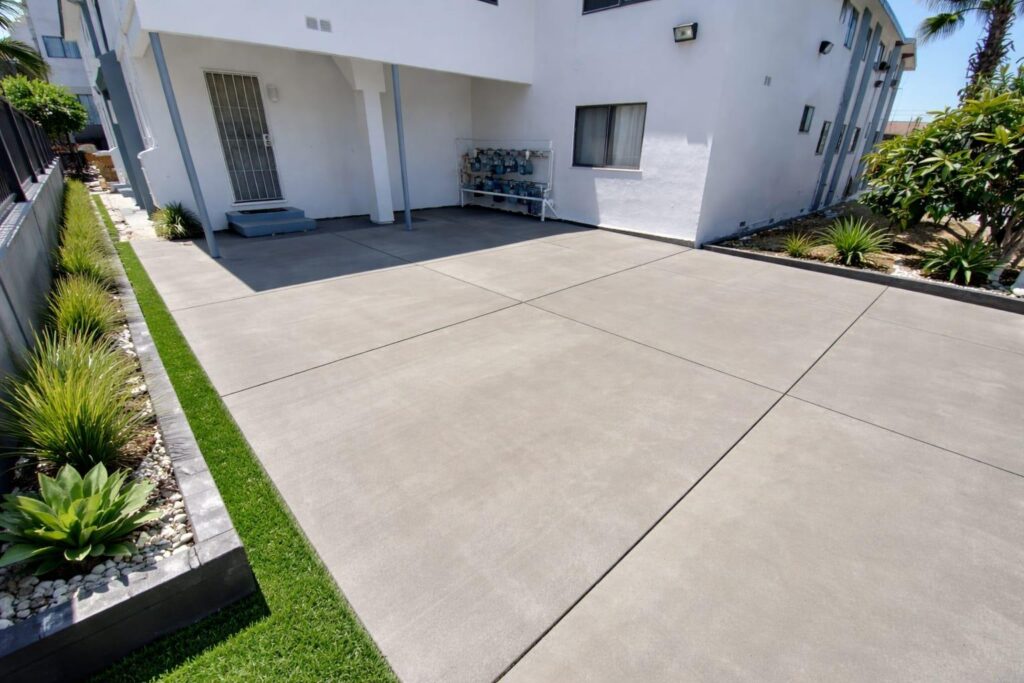
Concrete is the most cost-effective, lowest-maintenance outdoor surface you can install, when it’s done right. That means proper sub-base compaction, correct mix design, appropriate water-cement ratio, control joints at the right intervals, and a finish that drains and doesn’t trap water.
For Los Angeles county properties we pour concrete driveways, patios, walkways, exposed aggregate surfaces, broom-finish slabs, and stamped concrete with decorative patterns. Every pour includes proper curing and sealing as standard, not an upsell.
Concrete Poured For Strength
01
Proper mix design
3,000 PSI for pedestrian surfaces, 4,000 PSI for driveways, water-cement ratio held at spec, no water added at the truck on site.
02
Control joints at correct intervals
Scored or formed control joints at 8–12-foot intervals for standard slabs, where the concrete wants to crack, it cracks cleanly and invisibly.
03
Compacted sub-base
Class II base compacted in lifts under every slab, no poured concrete over loose or disturbed soil, which is where settlement cracks come from.
04
Finish options
Broom finish, exposed aggregate, salt finish, stamped patterns, and smooth trowel finish, with integral color or acid stain for decorative applications.
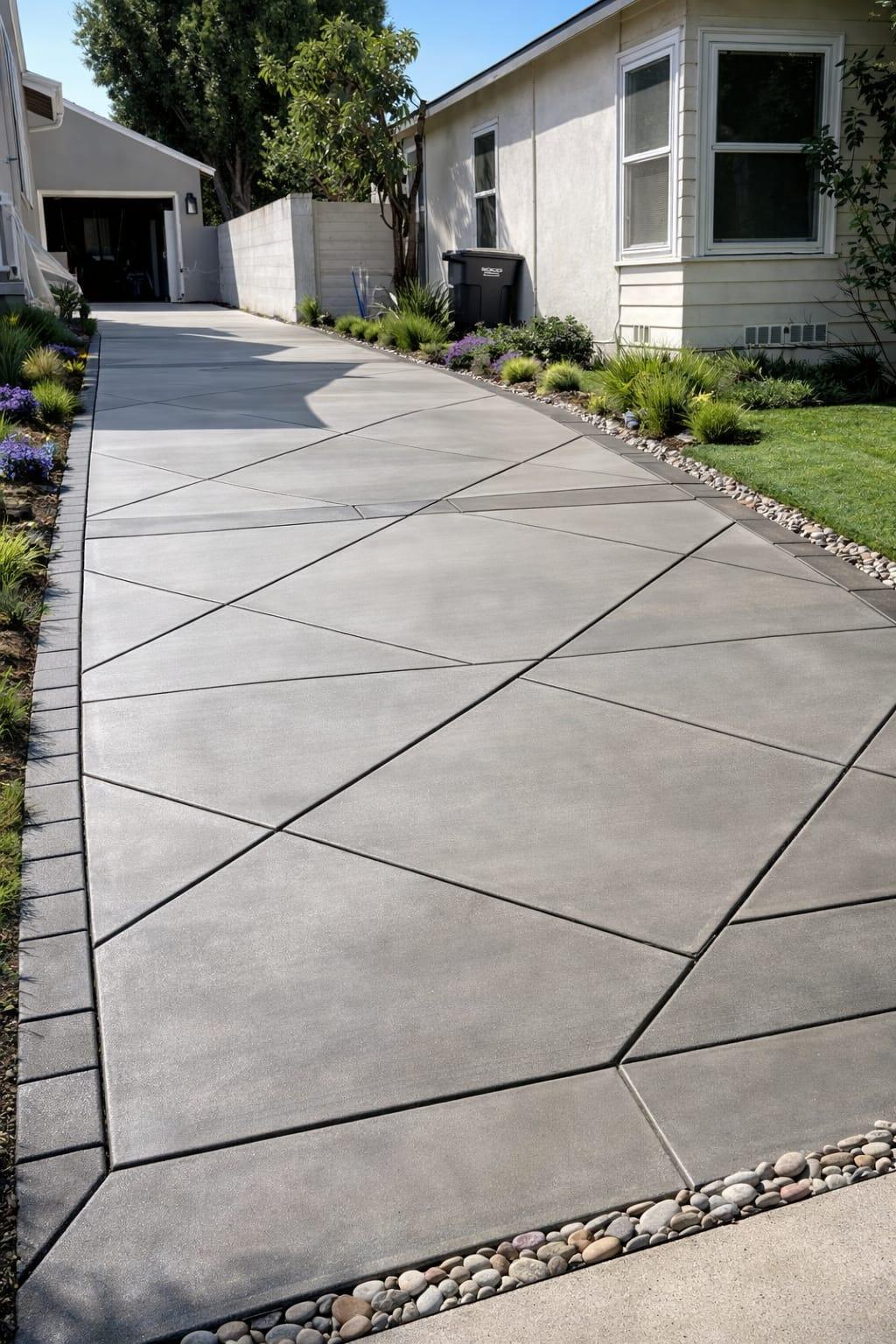
Concrete cracks when the sub-base settles unevenly, when control joints are missing, or when the mix is too wet at pour. We address all three: compacted base in lifts, control joints scored or formed at 8–12-foot intervals, and mix design specified for the application, standard 3,000 PSI for patios, 4,000 PSI for driveways and vehicular surfaces.
Don’t add water to the truck at the pour to make the mix more workable. That’s the industry shortcut that causes crazing, scaling, and early cracking. Our crews work at proper slump, it takes more effort, and the slab lasts.
Expert Concrete Services in Los Angeles
01Layout & Demo
Existing surfaces are broken out and removed. Grades are established for drainage slope.
02Sub-base & Forms
Base material compacted in lifts; forms set at finished grade elevation with correct drainage pitch.
03Pour & Finish
Concrete is placed, screeded, and finished to specified surface texture. Control joints formed or cut after initial set.
04Cure & Seal
Curing compound applied immediately after finishing. Penetrating sealer applied at 28 days after full cure.
Set in base. Built to last.
“Concrete doesn’t fail, improper sub-base, wrong mix design, and missing control joints fail. Get those three right and a concrete slab lasts indefinitely.”Line of Art Construction
Materials & applications.
Concrete driveways
- Standard broom finish, 4″ slab over compacted base, #3 rebar on 18″ grid, control joints at 10-foot intervals, broom texture for traction.
- Exposed aggregate, Surface aggregate exposed by washing away the cement paste while green, decorative, slip-resistant, and durable.
- Stamped concrete driveway, Stamped with cobblestone, brick, or custom patterns and colored with integral pigment or release agent.
Patios & walkways
- Smooth finish patio, Trowel-smooth finish for contemporary outdoor dining areas; integral color or acid stain finish available.
- Stamped patio, Stamped patterns (Ashlar slate, Yorkstone, wood plank) for patios that look like natural stone without the cost.
- Salt finish, Rock salt pressed into the surface before cure creates a pitted, slip-resistant texture popular for pool decks.
Pool decks
- Broom finish deck, Standard broom-finish concrete around pool perimeter with expansion joints at bond beam.
- Kool Deck / overlay, Cementitious topping over existing concrete deck, cooler underfoot, slip-resistant, multiple color options.
- Exposed aggregate deck, Cool-feel pebble aggregate surface that stays comfortable barefoot in LA sun.
Concrete FAQ
Questions Los Angeles Homeowners Ask Us
Why does concrete crack in Los Angeles?
Mostly because of what is underneath it. Much of the LA basin and the San Fernando Valley sits on clay-heavy soils that swell when wet and shrink through long dry summers, and a slab poured on inadequate or poorly compacted base moves with that ground. Add seismic activity and the result is cracking. Some hairline cracking is normal in any concrete as it cures and shrinks; what is avoidable is structural cracking from a thin base, missing or badly placed reinforcement, and control joints cut too shallow or too far apart.
Concrete or pavers — which should I choose?
Concrete costs less up front and goes down faster. Pavers cost more initially and behave better over time on this ground: a paver surface is individual units over a flexible base, so it absorbs seasonal soil movement by settling slightly rather than fracturing, and a damaged section can be lifted and reset without touching the rest. A cracked slab means demolition and replacement. Over a twenty year horizon that repairability is often worth more than the initial difference. For a large driveway on stable flat ground, concrete remains a sound, economical choice.
How long before I can use new concrete?
Foot traffic is generally fine within a day or two, vehicles considerably longer — concrete reaches most of its strength over the first month, and driving on it too early is how edges crack. In Los Angeles heat the bigger risk is curing too fast: water leaving the surface quickly causes shrinkage cracking and a weaker surface, which is why proper curing, not just pouring, separates work that lasts from work that does not.
What about stamped and decorative finishes?
Stamped concrete, integral colour, exposed aggregate and broom finishes are all available, and colour is the thing to think carefully about: a dark stamped driveway or pool deck in Woodland Hills or Chatsworth gets genuinely hot underfoot in summer. Stamped surfaces also typically need periodic resealing to keep colour and slip resistance, which is ongoing maintenance a plain broom finish does not carry.
Do I need a permit for concrete work?
At-grade flatwork inside the property line often needs no building permit, but work in the public right of way — including the driveway approach between the sidewalk and the street — is permitted separately and administered by the city. Concrete retaining walls above the exempt height need engineering and permits in their own right, and projects adding or replacing significant impervious surface can trigger stormwater management requirements. We confirm what applies to your parcel.
Can you resurface rather than replace my concrete?
Sometimes. Overlays and resurfacing work where the slab is structurally sound and the problem is cosmetic — staining, surface wear, a dated finish. Where the slab has structural cracking, has settled unevenly, or sits on a failed base, resurfacing buries the problem and it returns within a season or two. Where a sound slab exists and you want a different look, laying pavers over the existing concrete can avoid demolition entirely. We tell you which situation you have. Estimates and 3D design are free.
Concrete set
to last decades.
From a front walkway to a full driveway replacement or backyard patio pour, we design and build concrete flatwork that drains, doesn’t crack, and looks right for decades.