Southern California is heading into the wettest winter outlook we have seen in years, and the encouraging part is that almost everything worth doing about it is work you would want done anyway. A property that handles a heavy winter well is simply a property that drains properly, and drainage is one of those quiet investments that protects everything else you have built out there.
In mid-November 2026, NOAA’s Climate Prediction Center confirmed that this El Niño has reached very strong status, only the sixth time that has happened since 1950. Forecasters put the odds of strong to very strong conditions continuing through January to March 2027 at better than seventy-nine percent, and the chance that this event exceeds every El Niño on record since 1950 at roughly sixty percent. The seasonal outlook favours above-normal precipitation across Southern California, and the regional predictive services assessment issued at the end of October went further still, warning that the potential for severe hydrologic impacts this winter should not be underestimated.
One honest note before we go any further, because it matters. El Niño shifts the probabilities rather than guaranteeing rain on any particular street, and the 2015 to 2016 event was also very strong and ended up underdelivering for Southern California. What a forecast like this really justifies is preparation rather than alarm, and preparation is time well spent because the measures that carry a property through a wet winter are the same ones that should have been in place from the beginning.
Why Los Angeles Properties Struggle in Heavy Rain
Rain here does not arrive gently. It comes in short, intense bursts, often as atmospheric rivers that deliver a season’s worth of water across a few days, and that pattern produces sheet flow across hard surfaces rather than steady absorption. Sheet flow is what scours edges, undermines paving and finds its way toward structures, which is why the design response is always about giving water somewhere deliberate to go.
Three local conditions make that more important here than almost anywhere else.
Clay soils. Much of the basin and the San Fernando Valley sits on clay-heavy ground that absorbs slowly, swells when it is saturated, and holds water against foundations and walls rather than letting it drain away freely.
Summer-baked ground. After a long dry season the top layer of soil can become hydrophobic enough that the first real rain largely runs off instead of soaking in, which is why the first storm of the season is so often the one that causes trouble rather than the biggest storm later on.
Hardscape coverage. Decades of patios, driveways and additions have reduced how much of a typical lot can absorb anything at all, so water that would once have soaked quietly into a garden now needs to be collected and carried somewhere on purpose.
The thread running through all of it is that nearly every rain failure on a residential property is a drainage failure rather than a materials failure. The paving did not give way because the paving was poor. It gave way because water went somewhere nobody had planned for, and that is a solvable problem.
Burn Scars Change the Rules Entirely
If your property sits within or below a recent burn area, this is the section that matters most, and it is worth reading carefully because the thresholds are far lower than most people expect.
Fire removes the vegetation that held soil in place and bakes the ground into a water-repellent layer, so rain that a hillside would once have absorbed runs straight off instead, picking up ash, soil, rock and anything else loose on the way down. The result is a debris flow, which behaves less like a flood and more like wet concrete moving downhill at speed.
The figures from this region are sobering. The U.S. Geological Survey has documented post-fire debris flows beginning at rainfall rates of around half an inch per hour, which is an ordinary Southern California storm rather than an extreme one. California’s State Geologist has noted that as little as a fifth of an inch of rain in fifteen minutes could trigger a debris flow in the Eaton burn scar. USGS modelling found a sixty to eighty percent chance of debris flows in Palisades-area canyons, including Temescal and Tuna, under a design storm scenario.
The National Weather Service treats burn areas as being at heightened risk of flash flooding and debris flows for at least two years after a fire, which puts the January 2025 Palisades, Eaton and Hurst scars and the December 2024 Franklin scar squarely inside their highest-risk window this winter.
Geography matters within that picture. The Eaton scar sits above extremely steep watersheds draining into Altadena, Pasadena and out toward Monrovia, which is why it has consistently been assessed as the higher debris-flow risk of the two large 2025 scars, while the Palisades terrain is more gently sloping with watersheds running to the ocean, a difference that changes the character of the hazard without removing it.
Two things follow from this for property owners in these areas. The first is that no amount of private drainage work stops a debris flow, and nobody should tell you otherwise. Property-level measures reduce damage from runoff and redirect ordinary storm water, which is valuable, but they do not hold back a hillside in motion. The second is that the official channels are the ones to rely on. Los Angeles County Public Works operates a mud and debris flow line on 1-800-933-0930, and residents in these areas should register for alerts at alert.lacounty.gov and have an evacuation plan ready rather than making a judgement call in the middle of a storm.
Drainage: Where Your Money Does the Most Good
For properties away from burn areas, drainage is far and away the most effective investment you can make before a wet winter, and the best part is that it disappears completely once the work is finished.
A working residential system has four parts, and in our experience the weak point is almost always the fourth.
Collection, meaning area drains at low points, channel drains across driveway entrances and thresholds, and catch basins wherever water concentrates, all with the job of intercepting water before it ever reaches a structure or an edge.
Conveyance, which is solid pipe sized and sloped to carry that water away properly. Flexible corrugated pipe laid without consistent fall is one of the most common faults we find, because it sags, holds water and silts up over time.
Subsurface drainage, using perforated collector pipe in aggregate wrapped in filter fabric, behind retaining walls and anywhere groundwater rather than surface water is the real issue. The filter fabric is what stops fines migrating in and blinding the aggregate, which is why it is never the place to economise.
A deliberate outlet, which is where most systems fall down. Water has to arrive somewhere legitimate, whether that is a street gutter, an approved connection or a designed dispersal area on the property, because a system that collects water beautifully and then discharges it against a neighbour’s wall or into the base of a slope has only moved the problem somewhere else.
Retaining Walls and Slopes
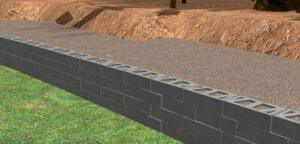
Retaining walls very rarely fail because the wall itself was too weak for the soil behind it. They fail because water got in behind them and had no way out, which is a design question rather than a strength question.
Saturated soil is both heavier and more mobile than dry soil, and water trapped behind a wall exerts hydrostatic pressure the wall may never have been designed to carry. That is why drainage behind a wall is not an accessory to the structure but part of it, and why aggregate backfill, a perforated collector at the base, filter fabric separating it from the surrounding soil, and an outlet that discharges are what carry a wall through a wet winter in good shape.
There are a few warning signs worth walking out and checking before the rain arrives: leaning or rotation at the top of a wall, which points to overturning pressure beyond what it was designed for; new cracking, particularly stepped cracking through block; weep holes that have never run during rain, which usually means they are blocked or there is no working drain behind them; and soil or efflorescence staining showing that water is passing through the wall rather than around it.
A surcharge added after a wall was built is a frequent culprit, so if a driveway, parking area, spa or structure has been placed above or behind a wall since it went in, that is worth having assessed. Our guide to retaining and block walls covers the engineering side in more depth if you want to understand what you are looking at.
Surfaces, Grading and the First Few Feet
The ground immediately around a building does more work than anything else on the property, and it should fall away from the structure consistently for at least the first several feet. A surprising number of Los Angeles homes have the opposite, usually because paving was added over the years and each layer raised the level a little until water began running back toward the house, which is an easy thing to correct once you know to look for it.
A few other details are worth checking while you are out there:
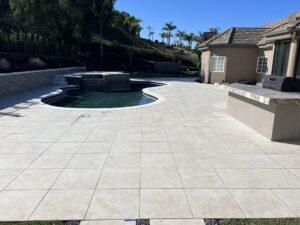
- Paving falls, because every hard surface needs somewhere to shed to, and a flat patio with no fall and no drain simply becomes a shallow pond.
- Settled slabs, since concrete that has dropped against a structure creates a channel aiming water straight at the building.
- Planter beds against walls, which hold saturated soil against a structure and cause slow, steady damage you may not notice for years.
- Downspouts, because one discharging at the foundation delivers your entire roof area to the worst possible point, and piping them away into the drainage system is a quick win.
- Permeable surfaces, where permeable paving on an open-graded base lets water infiltrate rather than sheet away and reduces the volume your drainage has to handle, working best on clay soils as a partner to a drainage system rather than a replacement for one.
What You Can Do Before the Next Storm
A good amount of this is maintenance you can take care of yourself this week, and it makes a real difference.
- Clear gutters, downspouts, area drains and channel drains of leaves and debris, since blocked drains are the most common cause of flooding that did not need to happen.
- Test the system with a hose by running water into each drain and confirming it arrives at the outlet, because anything that backs up or never appears is blocked or broken.
- Clear the first few feet around the structure and check that the ground falls away from it.
- Walk your slopes and walls looking for the warning signs above.
- Secure anything loose that could move in a storm or block a drain.
- Best of all, walk the property while it is actually raining, because ten minutes out there in the wet tells you more about where your water goes than any inspection in dry weather.
- If you are in or below a burn area, register for county alerts and have an evacuation plan.
What to Fix Properly, and When
The work that truly protects a property, meaning regrading, a designed drainage system, wall drainage, or rebuilding a failed surface on a correct base, is construction rather than maintenance, and it needs dry ground to be done well, since saturated soil cannot be compacted properly and excavation during a wet spell creates its own problems.
That leads to a simple rule of thumb on timing. If you already know about a serious drainage problem, it is far better addressed between storm systems or early in the season than left until spring, because the damage tends to compound. If your property is sound and the question is improvement rather than repair, the end of the wet season is the better moment, and the winter ahead becomes useful as a chance to observe exactly where your water wants to go.
The one thing worth resisting is a repair sold during a storm by someone knocking on the door, because drainage designed in a panic usually moves the problem rather than solving it. A system designed calmly, with the whole property in view, lasts for decades.
If you would like a proper assessment before the heavier storms arrive, that is exactly the kind of walkthrough we are happy to do. For the work itself, take a look at landscape construction, retaining walls and concrete and drainage, and our backyard remodeling guide for how grading and drainage sit at the start of any larger project.
Official sources worth following this winter
NOAA Climate Prediction Center for ENSO status and seasonal outlooks, the National Weather Service Los Angeles office for storm-specific warnings, the USGS post-fire debris flow hazard assessments for the Eaton and Palisades fires, and Los Angeles County Public Works for the mud and debris flow forecast and the alert registration above.